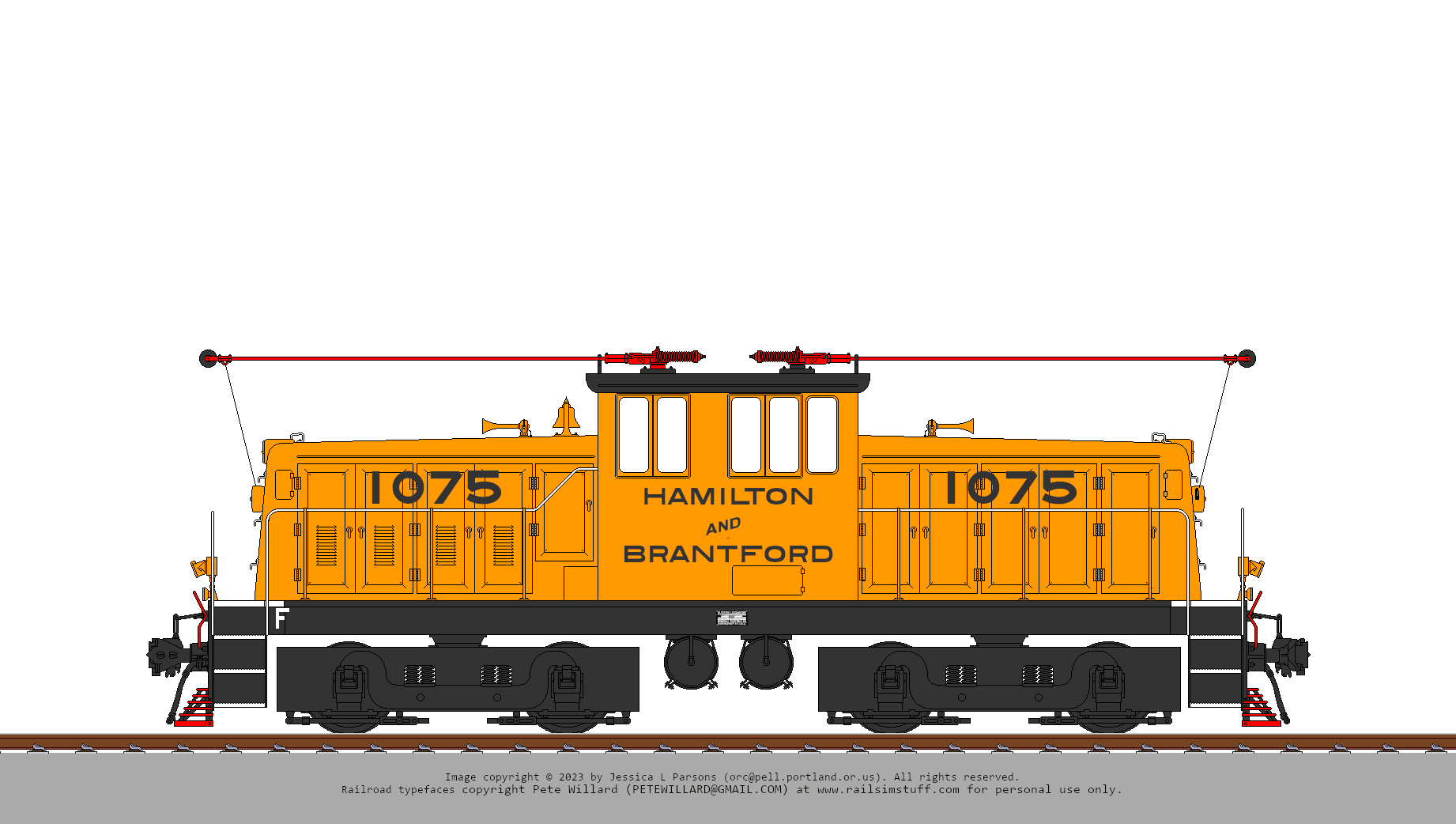
In 1908(ish), the Brantford & Hamilton Electric Railway opened their line, then spent the next 20-odd years carrying passengers (and a tiny bit of freight) between the to respective cities.
What was likely to happen (and nearly did) was that their owners would see the macadam writing on the wall and hot potato the radial as soon as the automobile took enough riders away to tip the books into the red, except that in 1924, the line down Hess St (in Hamilton) was extended into the waterfront so the railway could make some money shuffling freight around, and then in 1926 a business (“Ancaster Kitchen Tools”) opened along the line and started shipping raw materials up from Hamilton to make into pots & pans & other kitchen-shaped implements of destruction, which meant that when it became obvious that Cataract Power was about to be purchased by Ontario Hydro it was time to buy the (struggling) radial to keep the supply lines going. It was 1928, and times were good, so why not roll the dice?
So they rolled, and it came up a natural 20.
The newly renamed Brantford & Hamilton Air Line kept running passenger trains (2 cars in hourly service; at 45 MPH they could make it from end to end in 25 minutes, which gave ample time to also fit a daily freight train into the mix) because of franchise obligations for as long as it could, but by the end of the 1930s the roads were improved enough so that even the promise of through running with the LE&N (“as soon as we change our electrification to 1500vdc, promise!”) wasn’t enough to support more than two morning and two afternoon commuter trains.
The second world war provided a respite; passenger numbers went up enough to go back to hourly service, freight traffic (obviously) improved, and the railroad was riding higher on the hog up until the day when the city of Hamilton yanked the street-running franchise as part of a beautification project (you can look at modern maps that show easily 50% of downtown as nothing but parking lots to see how that worked out) and the industrial trackage by the harbour was suddenly disconnected from the rest of the railroad. The H&B managed to hang onto their trackage rights as far east as Hunter St, where they built an extension that connected to the TH&B’s line through Hamilton, but the previous midnight freight transfers along Hess became a more complicated thing involving a leased switcher & TH&B trackage rights.
In 1947, the H&B discontinued passenger service (after the Hess St trackage rights east of King St were rudely cut short, the H&B used Hamilton Street Railway trackage along Aberdeen, etc, to reach Hamilton Terminal, and most of that trackage was abandoned when the HSR converted the lines that used it to busses and trolleybusses) and became a strictly freight operation.
In 1948, the Hamilton harbour trackage was sold to the TH&B, leaving the “midnight freight” spur down Hess to King as the sole remainder of the H&B’s Hamilton city track, and – now that there were no longer any junctions with the HSR’s 600vdc trolley & trolleybus lines – the H&B finally switched tension to 1500vdc and could through run freight with the LE&N.
In 1958, the radial’s head office was moved from downtown Hamilton to the (now disused) Brantford Union Station, where it remains today, and, in 1962, the radial was renamed again to (just) the Hamilton & Brantford, and it continued operating under that name until 1973, when it merged with the TSR to form the ORRC.
In the 1980s, the TH&B abandoned their line from Hamilton to Brantford after a washout severed the line. There was still some industry at the Brantford end of the line, so that section was sold to the H&B, electrified, and serves as another industrial track.
Also in 2026 – after the United Railway Trust merged with CPKC – CPR’s Chedoke Park spur was transferred to the H&B because the CPR was only using it for car storage and didn’t want it on their books anymore.
The H&B continues to operate as a shortline serving six companies between Ancaster & Brantford. The line from Ancaster down into Hamilton sees very little traffic (holiday passenger service, railfan specials, and occasional light engine moves when cars are being shuffled into the Chedoke Park storage yard) and is being rebuilt into a rails with trails path by the city of Hamilton.
Roster
When the Brantford & Hamilton was purchased from Cataract Power it was using passenger equipment to handle the tiny amount of freight on the line, but this was supplemented almost immediately with a quartet of Baldwin steeplecabs, which spent the first 34 years of their life either servicing online industries or handling runthrough freight (via the LE&N) between the TSR & B&H/Air Line/H&B.
After the LE&N was dieselised, two of the steeplecabs went north to the TSR, first as loaners, and then – after the 1973 ORRC merger – permanently.
In 1992, the H&B purchased three used Niagara Junction E10Bs from that now-dieselised system, one of the remaining steeplecabs went into storage and the last – #1074 – was first stored, then leased to the Aroostook Valley Railway when that line reelectrified in 1996 (it returned from that lease in 2026 and is now stored in the Ancaster shops.)
One of the ORRC’s class O steeplecabs is lettered for the H&B, but it operates on the LE&N and southern half of the Grand River instead of H&B rails.